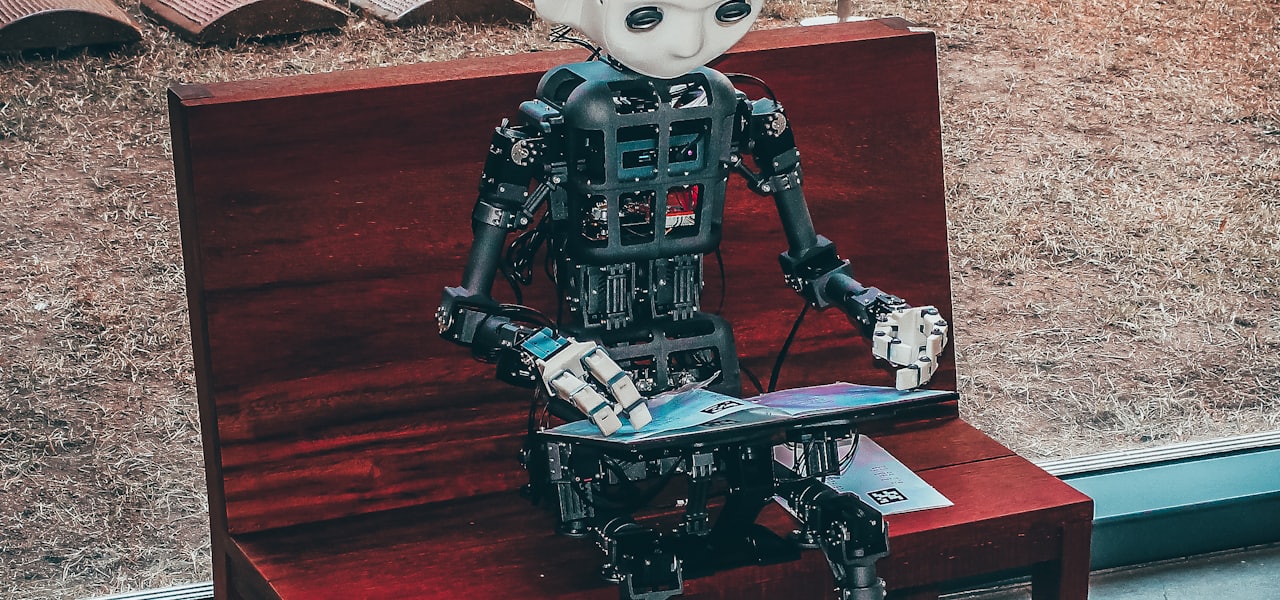
Trying to pick the best AI virtual assistant? An AI virtual assistant is software that uses machine learning to help you get more done — it scales effortlessly from a single task to thousands. The best picks balance beginner-friendly simplicity with the depth power users need, and they ship updates often. Whether you are a beginner or a pro, the right AI virtual assistant slots into your workflow and pays for itself fast. Read on for hands-on impressions, pricing tiers, and the standout features that matter.
Robotics
Robotics is the interdisciplinary study and practice of the design, construction, operation, and use of robots. A roboticist is someone who specializes in robotics. Robotics usually combines four aspects of design work: a power source (e.g. a battery), mechanical construction, a control system (electrical circuits), and software (run by remote control or artificial intelligence). The goal of most robotics is to design machines that can assist humans in various fields, such as agriculture, construction, domestic work, food processing, inventory management, manufacturing, medicine, military, mining, space exploration, and transportation. Robots impact humans by displacing workers. Some expect this to occur at an increasing rate, leading to proposed solutions such as basic income. Robotics is itself a lucrative business that creates careers, especially for postgraduates. Roboticists often aim to create machines that seem to interface naturally with humans. The field is under active research and development, with areas of interest including robot kinematics and quantum robotics. == Design == Robotics usually combines four aspects of design work to create a robot: Power source: Potential energy sources include wired electricity, a battery, and/or petrol. Mechanical construction: A physical form or combination of forms is designed to functionally achieve tasks within a given range of environments. This can include locomotive elements such as wheels and caterpillar tracks, as well as hydraulic limbs and manipulators (e.g. hands). Control system: Electrical circuits (utilizing components such as diodes and transistors) are used to run software, govern motor movement, and read sensors. Software: A program is how a robot decides when or how to do something. Robotic programs can be run by remote control, artificial intelligence (AI), or a hybrid of the two. AI programming is an important part of robotic navigation and human–robot interaction. === Power source === Many different types of batteries can be used as a power source. Most are lead–acid batteries, which are safe and have relatively long shelf lives but are rather heavy compared to silver–cadmium batteries, which are much smaller in volume and much more expensive. Designing a battery-powered robot needs to take into account factors such as safety, cycle lifetime, and weight. Generators, often some type of internal combustion engine, can also be used, but are often mechanically complex and inefficient. Additionally, a tether could connect the robot to a power supply, saving weight and space, but requiring a cumbersome cable. Potential power sources include: Flywheel energy storage Hydraulics Nuclear Organic garbage (through anaerobic digestion) Pneumatics (compressed gases) Solar power === Mechanical construction === Actuators are the "muscles" of a robot, the parts which convert stored energy into movement. The most popular actuators are electric motors that rotate a wheel or gear and linear actuators that control factory robots. Most robots use electric motors—often brushed and brushless DC motors in portable robots or AC motors in industrial robots and computer numerical control machines—especially in systems with lighter loads and where the predominant form of motion is rotational. Meanwhile, linear actuators move in and out and often have quicker direction changes, particularly when large forces are needed, such as with industrial robotics. They are typically powered by oil or compressed air, but can also be powered by electricity, usually via a motor and a leadscrew. The mechanical rack and pinion is common. Recent alternatives to DC motors are piezoelectric motors, including ultrasonic motors, in which tiny piezoceramic elements vibrate many thousands of times per second, causing linear or rotary motion. One type uses the vibration of the piezo elements to step the motor in a circle or a straight line; another type uses the piezo elements to vibrate a nut or drive a screw. The advantages of these motors are nanometer resolution, speed, and force for their size. Series elastic actuation (SEA) relies on introducing intentional elasticity between the motor actuator and the load for robust force control. Due to the resultant lower reflected inertia, series elastic actuation improves safety during robot interactions or collisions. Further, it provides energy efficiency and shock absorption (mechanical filtering) while reducing excessive wear on the transmission and other components. This approach has successfully been employed in various robots, particularly advanced manufacturing robots and walking humanoid robots. The controller design of a series elastic actuator is most often performed within the passivity framework as it ensures the safety of interaction with unstructured environments. However, this framework suffers from stringent limitations imposed on the controller, which may impact performance. Pneumatic artificial muscles, also known as air muscles, are special tubes that expand (typically up to 42%) when air is forced inside them; they are used in some robot applications. Muscle wire, also known as shape memory alloy, is a material that contracts (under 5%) when electricity is applied; they have been used for some small robots. Electroactive polymers are a plastic material that can contract substantially (up to 380% activation strain) from electricity and have been used in the facial muscles and arms of humanoid robots, as well as to enable new robots to float, fly, swim or walk. Additionally, elastic carbon nanotubes are a promising experimental artificial muscle technology. The absence of defects in carbon nanotubes enables these filaments to deform elastically by several percent, with energy storage levels of perhaps 10 J/cm3 for metal nanotubes. Human biceps could be replaced with wire of this material measuring 8 millimetres (3⁄8 in) in diameter, feasibly allowing future robots to outperform humans. ==== Locomotion ==== Robots with only one or two wheel(s) can have advantages such as greater efficiency, reduced parts, and navigation through confined areas. A one-wheeled robot balances on a round ball; Carnegie Mellon University's Ballbot is the approximate height and width of a person. Several attempts have also been made to build spherical robots (also known as orb bots or ball bots), which move by spinning a weight inside the ball or rotating outer shells. Two-wheeled balancing robots generally use a gyroscope to detect how much a robot is falling and drive the wheels proportionally up to hundreds of times per second to counterbalance the fall, based on inverted pendulum dynamics. NASA's Robonaut has been mounted to a Segway for a similar effect. Most mobile robots have four wheels or continuous tracks. Six wheels can give better traction in outdoor terrain, while tracks provide even more grip. Tracked wheels are common for outdoor off-road robots, but are difficult to use indoors. A small number of skating robots have been developed, one of which is a multimodal walking and skating device with four legs and unpowered wheels. Several robots have been made that can walk on two legs, but not yet as reliably as a human. Many other robots have been built that walk on more than two legs, being significantly easier. Walking robots could be used for uneven terrains, providing a high degree of mobility and efficiency, but two-legged robots can currently only handle flat floors or perhaps stairs. Some approaches have included: The zero moment point (ZMP) is the algorithm used by robots such as Honda's ASIMO. The robot's onboard computer tries to keep the total inertial forces (the combination of Earth's gravity and the acceleration and deceleration of walking) exactly opposed by the floor reaction force (the force of the floor pushing back on the robot's foot). In this way, the two forces cancel out, leaving no moment (force causing the robot to rotate and fall over). Human observers note that this is not exactly how a human walks, with some describing ASIMO's walk as looking like it needs use the bathroom. ASIMO's walking algorithm utilizes some dynamic balancing, but requires a flat surface. Several robots, built in the 1980s by Marc Raibert at the MIT Leg Laboratory, successfully demonstrated very dynamic walking. Initially, a robot with only one leg, and a very small foot could stay upright simply by hopping. The movement is the same as that of a person on a pogo stick. As the robot falls to one side, it would jump slightly in that direction to catch itself. Soon, the algorithm was generalized to two and four legs. A bipedal robot was demonstrated running and even performing somersaults. A quadruped was also demonstrated which could trot, run, pace, and bound. A more advanced approach is a dynamic balancing algorithm, which constantly monitors the robot's motion and places the feet to maintain stability. This technique has been demonstrated by Anybots' Dexter robot (
Albert One
Albert One is an artificial intelligence chatbot created by Robby Garner and designed to mimic the way humans make conversations using a multi-faceted approach in natural language programming. == History == In both 1998 and 1999, Albert One won the Loebner Prize Contest, a competition between chatterbots. Some parts of Albert were deployed on the internet beginning in 1995, to gather information about what kinds of things people would say to a chatterbot. Another element of Albert One involved the building of a large database of human statements, and associated replies. This portion of the project was tested at the 1994-1997 Loebner Prize contests. Albert was the first of Robby Garner's multifaceted bots. The Albert One system was composed of several subsystems. Among those were a version of Eliza, the therapist, Elivs, another Eliza-like bot, and several other helper applications working together in a hierarchical arrangement. As a continuation of the stimulus-response library, various other database queries and assertions were tested to arrive at each of Albert's responses. Robby went on to develop networked examples of this kind of hierarchical "glue" at The Turing Hub.
Neural field
In machine learning, a neural field (also known as implicit neural representation, neural implicit, or coordinate-based neural network), is a mathematical field that is fully or partially parametrized by a neural network. Initially developed to tackle visual computing tasks, such as rendering or reconstruction (e.g., neural radiance fields), neural fields emerged as a promising strategy to deal with a wider range of problems, including surrogate modelling of partial differential equations, such as in physics-informed neural networks. Differently from traditional machine learning algorithms, such as feed-forward neural networks, convolutional neural networks, or transformers, neural fields do not work with discrete data (e.g. sequences, images, tokens), but map continuous inputs (e.g., spatial coordinates, time) to continuous outputs (i.e., scalars, vectors, etc.). This makes neural fields not only discretization independent, but also easily differentiable. Moreover, dealing with continuous data allows for a significant reduction in space complexity, which translates to a much more lightweight network. == Formulation and training == According to the universal approximation theorem, provided adequate learning, sufficient number of hidden units, and the presence of a deterministic relationship between the input and the output, a neural network can approximate any function to any degree of accuracy. Hence, in mathematical terms, given a field y = Φ ( x ) {\textstyle {\boldsymbol {y}}=\Phi ({\boldsymbol {x}})} , with x ∈ R n {\displaystyle {\boldsymbol {x}}\in \mathbb {R} ^{n}} and y ∈ R m {\displaystyle {\boldsymbol {y}}\in \mathbb {R} ^{m}} , a neural field Ψ θ {\displaystyle \Psi _{\theta }} , with parameters θ {\displaystyle {\boldsymbol {\theta }}} , is such that: Ψ θ ( x ) = y ^ ≈ y {\displaystyle \Psi _{\theta }({\boldsymbol {x}})={\hat {\boldsymbol {y}}}\approx {\boldsymbol {y}}} === Training === For supervised tasks, given N {\displaystyle N} examples in the training dataset (i.e., ( x i , y i ) ∈ D t r a i n , i = 1 , … , N {\displaystyle ({\boldsymbol {x_{i}}},{\boldsymbol {y_{i}}})\in {\mathcal {D_{train}}},i=1,\dots ,N} ), the neural field parameters can be learned by minimizing a loss function L {\displaystyle {\mathcal {L}}} (e.g., mean squared error). The parameters θ ~ {\displaystyle {\tilde {\theta }}} that satisfy the optimization problem are found as: θ ~ = argmin θ 1 N ∑ ( x i , y i ) ∈ D t r a i n L ( Ψ θ ( x i ) , y i ) {\displaystyle {\tilde {\boldsymbol {\theta }}}={\underset {\boldsymbol {\theta }}{\text{argmin}}}\;{\frac {1}{N}}\sum _{({\boldsymbol {x_{i}}},{\boldsymbol {y_{i}}})\in {\mathcal {D_{train}}}}{\mathcal {L}}(\Psi _{\theta }({\boldsymbol {x}}_{i}),{\boldsymbol {y}}_{i})} Notably, it is not necessary to know the analytical expression of Φ {\displaystyle \Phi } , for the previously reported training procedure only requires input-output pairs. Indeed, a neural field is able to offer a continuous and differentiable surrogate of the true field, even from purely experimental data. Moreover, neural fields can be used in unsupervised settings, with training objectives that depend on the specific task. For example, physics-informed neural networks may be trained on just the residual. === Spectral bias === As for any artificial neural network, neural fields may be characterized by a spectral bias (i.e., the tendency to preferably learn the low frequency content of a field), possibly leading to a poor representation of the ground truth. In order to overcome this limitation, several strategies have been developed. For example, SIREN uses sinusoidal activations, while the Fourier-features approach embeds the input through sines and cosines. == Conditional neural fields == In many real-world cases, however, learning a single field is not enough. For example, when reconstructing 3D vehicle shapes from Lidar data, it is desirable to have a machine learning model that can work with arbitrary shapes (e.g., a car, a bicycle, a truck, etc.). The solution is to include additional parameters, the latent variables (or latent code) z ∈ R d {\displaystyle {\boldsymbol {z}}\in \mathbb {R} ^{d}} , to vary the field and adapt it to diverse tasks. === Latent code production === When dealing with conditional neural fields, the first design choice is represented by the way in which the latent code is produced. Specifically, two main strategies can be identified: Encoder: the latent code is the output of a second neural network, acting as an encoder. During training, the loss function is the objective used to learn the parameters of both the neural field and the encoder. Auto-decoding: each training example has its own latent code, jointly trained with the neural field parameters. When the model has to process new examples (i.e., not originally present in the training dataset), a small optimization problem is solved, keeping the network parameters fixed and only learning the new latent variables. Since the latter strategy requires additional optimization steps at inference time, it sacrifices speed, but keeps the overall model smaller. Moreover, despite being simpler to implement, an encoder may harm the generalization capabilities of the model. For example, when dealing with a physical scalar field f : R 2 → R {\displaystyle f:\mathbb {R} ^{2}\rightarrow \mathbb {R} } (e.g., the pressure of a 2D fluid), an auto-decoder-based conditional neural field can map a single point to the corresponding value of the field, following a learned latent code z {\displaystyle {\boldsymbol {z}}} . However, if the latent variables were produced by an encoder, it would require access to the entire set of points and corresponding values (e.g. as a regular grid or a mesh graph), leading to a less robust model. === Global and local conditioning === In a neural field with global conditioning, the latent code does not depend on the input and, hence, it offers a global representation (e.g., the overall shape of a vehicle). However, depending on the task, it may be more useful to divide the domain of x {\displaystyle {\boldsymbol {x}}} in several subdomains, and learn different latent codes for each of them (e.g., splitting a large and complex scene in sub-scenes for a more efficient rendering). This is called local conditioning. === Conditioning strategies === There are several strategies to include the conditioning information in the neural field. In the general mathematical framework, conditioning the neural field with the latent variables is equivalent to mapping them to a subset θ ∗ {\displaystyle {\boldsymbol {\theta }}^{}} of the neural field parameters: θ ∗ = Γ ( z ) {\displaystyle {\boldsymbol {\theta }}^{}=\Gamma ({\boldsymbol {z}})} In practice, notable strategies are: Concatenation: the neural field receives, as input, the concatenation of the original input x {\displaystyle {\boldsymbol {x}}} with the latent codes z {\displaystyle {\boldsymbol {z}}} . For feed-forward neural networks, this is equivalent to setting θ ∗ {\displaystyle {\boldsymbol {\theta }}^{}} as the bias of the first layer and Γ ( z ) {\displaystyle \Gamma ({\boldsymbol {z}})} as an affine transformation. Hypernetworks: a hypernetwork is a neural network that outputs the parameters of another neural network. Specifically, it consists of approximating Γ ( z ) {\displaystyle \Gamma ({\boldsymbol {z}})} with a neural network Γ ^ γ ( z ) {\displaystyle {\hat {\Gamma }}_{\gamma }({\boldsymbol {z}})} , where γ {\displaystyle {\boldsymbol {\gamma }}} are the trainable parameters of the hypernetwork. This approach is the most general, as it allows to learn the optimal mapping from latent codes to neural field parameters. However, hypernetworks are associated to larger computational and memory complexity, due to the large number of trainable parameters. Hence, leaner approaches have been developed. For example, in the Feature-wise Linear Modulation (FiLM), the hypernetwork only produces scale and bias coefficients for the neural field layers. === Meta-learning === Instead of relying on the latent code to adapt the neural field to a specific task, it is also possible to exploit gradient-based meta-learning. In this case, the neural field is seen as the specialization of an underlying meta-neural-field, whose parameters are modified to fit the specific task, through a few steps of gradient descent. An extension of this meta-learning framework is the CAVIA algorithm, that splits the trainable parameters in context-specific and shared groups, improving parallelization and interpretability, while reducing meta-overfitting. This strategy is similar to the auto-decoding conditional neural field, but the training procedure is substantially different. == Applications == Thanks to the possibility of efficiently modelling diverse mathematical fields with neural networks, neural fields have been applied to a wide range of problems: 3D scene reconstruction: neural fields can be used to model t
Huroof
Huroof (Arabic: حروف, lit. 'letters') is an Android kids application produced by the Islamic State, specifically the Islamic States' Al-Himmah Library, which is targeted towards kids in order to teach kids the Arabic alphabet, and to also get kids to support the Islamic State and its practices. == Application == Huroof uses child-like appearances on the main menu, and throughout multiple of Huroof's in-game games for learning the alphabet, a lot of the games reference jihadist concepts, including imagery of weapons (such as missile, tank, cannon, sword,...), 'violent' images, as well as Islamic State imagery, including the flag of the Islamic State, Huroof uses nasheeds from Ajnad Media Foundation for audio production in the app. Reportedly, Huroof was released via Telegram channels of the Islamic State, as well as other file sharing websites. It is not the first moblie app released by Islamic State, but it is the first time they released a moblie application targeting children. === Nasheed game === In the Huroof app, there's a game where you listen to a radio, with the Al-Bayan logo on it, and learn the Arabic alphabet while the nasheed plays. === Writing game === In Huroof, there's a game where you can write out letters of the Arabic alphabet, as well as numbers while a small child tells you what they are. === Letter choosing game === In the app, there's a game they shows you images, and you choose which letter that image/item starts with.
Stixel
In computer vision, a stixel (portmanteau of "stick" and "pixel") is a superpixel representation of depth information in an image, in the form of a vertical stick that approximates the closest obstacles within a certain vertical slice of the scene. Introduced in 2009, stixels have applications in robotic navigation and advanced driver-assistance systems, where they can be used to define a representation of robotic environments and traffic scenes with a medium level of abstraction. == Definition == One of the problems of scene understanding in computer vision is to determine horizontal freespace around the camera, where the agent can move, and the vertical obstacles delimiting it. An image can be paired with depth information (produced e.g. from stereo disparity, lidar, or monocular depth estimation), allowing a dense tridimensional reconstruction of the observed scene. One drawback of dense reconstruction is the large amount of data involved, since each pixel in the image is mapped to an element of a point cloud. Vision problems characterised by planar freespace delimited by mostly vertical obstacles, such as traffic scenes or robotic navigation, can benefit from a condensed representation that allows to save memory and processing time. Stixels are thin vertical rectangles representing a slice of a vertical surface belonging to the closest obstacle in the observed scene. They allow to dramatically reduce the amount of information needed to represent a scene in such problems. A stixel is characterised by three parameters: vertical coordinate of the bottom, height of the stick, and depth. Stixels have fixed width, with each stixel spanning over a certain number of image columns, allowing downsampling of the horizontal image resolution. In the original formulation, each column of the image would contain at most one stixel, and later extensions were developed to allow multiple stixels on each column, allowing to represent multiple objects at different distances. == Stixel estimation == The input to stixel estimation is a dense depth map, that can be computed from stereo disparity or other means. The original approach computes an occupancy grid that can be segmented to estimate the freespace, with dynamic programming providing an efficient method to find an optimal segmentation. Alternative approaches can be used instead of occupancy grid mapping, such as manifold-based methods. The freespace boundary provides the base points of the obstacles at closest longitudinal distance, however multiple objects at different distances might appear in each column of the image. To fully define the obstacles, their height should be estimated, and this is accomplished by segmenting the depth of the object from the depth of the background. A membership function over the pixels can be defined based on the depth value, where the membership represents the confidence of a pixel belonging to the closest vertical obstacle or to the background, and a cut separating the obstacles from the background can again be computed effectively with dynamic programming. Once both the freespace and the obstacle height are known, the stixels can be estimated by fusing the information over the columns spanned by each stixel, and finally a refined depth of the stixel can be estimated via model fitting over the depth of the pixels covered by the stixel, possibly paired with confidence information (e.g. disparity confidence produced by methods such as semi-global matching).
Scale space implementation
In the areas of computer vision, image analysis and signal processing, the notion of scale-space representation is used for processing measurement data at multiple scales, and specifically enhance or suppress image features over different ranges of scale (see the article on scale space). A special type of scale-space representation is provided by the Gaussian scale space, where the image data in N dimensions is subjected to smoothing by Gaussian convolution. Most of the theory for Gaussian scale space deals with continuous images, whereas one when implementing this theory will have to face the fact that most measurement data are discrete. Hence, the theoretical problem arises concerning how to discretize the continuous theory while either preserving or well approximating the desirable theoretical properties that lead to the choice of the Gaussian kernel (see the article on scale-space axioms). This article describes basic approaches for this that have been developed in the literature, see also for an in-depth treatment regarding the topic of approximating the Gaussian smoothing operation and the Gaussian derivative computations in scale-space theory, and for a complementary treatment regarding hybrid discretization methods. == Statement of the problem == The Gaussian scale-space representation of an N-dimensional continuous signal, f C ( x 1 , ⋯ , x N , t ) , {\displaystyle f_{C}\left(x_{1},\cdots ,x_{N},t\right),} is obtained by convolving fC with an N-dimensional Gaussian kernel: g N ( x 1 , ⋯ , x N , t ) . {\displaystyle g_{N}\left(x_{1},\cdots ,x_{N},t\right).} In other words: L ( x 1 , ⋯ , x N , t ) = ∫ u 1 = − ∞ ∞ ⋯ ∫ u N = − ∞ ∞ f C ( x 1 − u 1 , ⋯ , x N − u N , t ) ⋅ g N ( u 1 , ⋯ , u N , t ) d u 1 ⋯ d u N . {\displaystyle L\left(x_{1},\cdots ,x_{N},t\right)=\int _{u_{1}=-\infty }^{\infty }\cdots \int _{u_{N}=-\infty }^{\infty }f_{C}\left(x_{1}-u_{1},\cdots ,x_{N}-u_{N},t\right)\cdot g_{N}\left(u_{1},\cdots ,u_{N},t\right)\,du_{1}\cdots du_{N}.} However, for implementation, this definition is impractical, since it is continuous. When applying the scale space concept to a discrete signal fD, different approaches can be taken. This article is a brief summary of some of the most frequently used methods. == Separability == Using the separability property of the Gaussian kernel g N ( x 1 , … , x N , t ) = G ( x 1 , t ) ⋯ G ( x N , t ) {\displaystyle g_{N}\left(x_{1},\dots ,x_{N},t\right)=G\left(x_{1},t\right)\cdots G\left(x_{N},t\right)} the N-dimensional convolution operation can be decomposed into a set of separable smoothing steps with a one-dimensional Gaussian kernel G along each dimension L ( x 1 , ⋯ , x N , t ) = ∫ u 1 = − ∞ ∞ ⋯ ∫ u N = − ∞ ∞ f C ( x 1 − u 1 , ⋯ , x N − u N , t ) G ( u 1 , t ) d u 1 ⋯ G ( u N , t ) d u N , {\displaystyle L(x_{1},\cdots ,x_{N},t)=\int _{u_{1}=-\infty }^{\infty }\cdots \int _{u_{N}=-\infty }^{\infty }f_{C}(x_{1}-u_{1},\cdots ,x_{N}-u_{N},t)G(u_{1},t)\,du_{1}\cdots G(u_{N},t)\,du_{N},} where G ( x , t ) = 1 2 π t e − x 2 2 t {\displaystyle G(x,t)={\frac {1}{\sqrt {2\pi t}}}e^{-{\frac {x^{2}}{2t}}}} and the standard deviation of the Gaussian σ is related to the scale parameter t according to t = σ2. Separability will be assumed in all that follows, even when the kernel is not exactly Gaussian, since separation of the dimensions is the most practical way to implement multidimensional smoothing, especially at larger scales. Therefore, the rest of the article focuses on the one-dimensional case. == The sampled Gaussian kernel == When implementing the one-dimensional smoothing step in practice, the presumably simplest approach is to convolve the discrete signal fD with a sampled Gaussian kernel: L ( x , t ) = ∑ n = − ∞ ∞ f ( x − n ) G ( n , t ) {\displaystyle L(x,t)=\sum _{n=-\infty }^{\infty }f(x-n)\,G(n,t)} where G ( n , t ) = 1 2 π t e − n 2 2 t {\displaystyle G(n,t)={\frac {1}{\sqrt {2\pi t}}}e^{-{\frac {n^{2}}{2t}}}} (with t = σ2) which in turn is truncated at the ends to give a filter with finite impulse response L ( x , t ) = ∑ n = − M M f ( x − n ) G ( n , t ) {\displaystyle L(x,t)=\sum _{n=-M}^{M}f(x-n)\,G(n,t)} for M chosen sufficiently large (see error function) such that 2 ∫ M ∞ G ( u , t ) d u = 2 ∫ M t ∞ G ( v , 1 ) d v < ε . {\displaystyle 2\int _{M}^{\infty }G(u,t)\,du=2\int _{\frac {M}{\sqrt {t}}}^{\infty }G(v,1)\,dv<\varepsilon .} A common choice is to set M to a constant C times the standard deviation of the Gaussian kernel M = C σ + 1 = C t + 1 {\displaystyle M=C\sigma +1=C{\sqrt {t}}+1} where C is often chosen somewhere between 3 and 6. Using the sampled Gaussian kernel can, however, lead to implementation problems, in particular when computing higher-order derivatives at finer scales by applying sampled derivatives of Gaussian kernels. When accuracy and robustness are primary design criteria, alternative implementation approaches should therefore be considered. For small values of ε (10−6 to 10−8) the errors introduced by truncating the Gaussian are usually negligible. For larger values of ε, however, there are many better alternatives to a rectangular window function. For example, for a given number of points, a Hamming window, Blackman window, or Kaiser window will do less damage to the spectral and other properties of the Gaussian than a simple truncation will. Notwithstanding this, since the Gaussian kernel decreases rapidly at the tails, the main recommendation is still to use a sufficiently small value of ε such that the truncation effects are no longer important. == The discrete Gaussian kernel == A more refined approach is to convolve the original signal with the discrete Gaussian kernel T(n, t) L ( x , t ) = ∑ n = − ∞ ∞ f ( x − n ) T ( n , t ) {\displaystyle L(x,t)=\sum _{n=-\infty }^{\infty }f(x-n)\,T(n,t)} where T ( n , t ) = e − t I n ( t ) {\displaystyle T(n,t)=e^{-t}I_{n}(t)} and I n ( t ) {\displaystyle I_{n}(t)} denotes the modified Bessel functions of integer order, n. This is the discrete counterpart of the continuous Gaussian in that it is the solution to the discrete diffusion equation (discrete space, continuous time), just as the continuous Gaussian is the solution to the continuous diffusion equation. This filter can be truncated in the spatial domain as for the sampled Gaussian L ( x , t ) = ∑ n = − M M f ( x − n ) T ( n , t ) {\displaystyle L(x,t)=\sum _{n=-M}^{M}f(x-n)\,T(n,t)} or can be implemented in the Fourier domain using a closed-form expression for its discrete-time Fourier transform: T ^ ( θ , t ) = ∑ n = − ∞ ∞ T ( n , t ) e − i θ n = e t ( cos θ − 1 ) . {\displaystyle {\widehat {T}}(\theta ,t)=\sum _{n=-\infty }^{\infty }T(n,t)\,e^{-i\theta n}=e^{t(\cos \theta -1)}.} With this frequency-domain approach, the scale-space properties transfer exactly to the discrete domain, or with excellent approximation using periodic extension and a suitably long discrete Fourier transform to approximate the discrete-time Fourier transform of the signal being smoothed. Moreover, higher-order derivative approximations can be computed in a straightforward manner (and preserving scale-space properties) by applying small support central difference operators to the discrete scale space representation. As with the sampled Gaussian, a plain truncation of the infinite impulse response will in most cases be a sufficient approximation for small values of ε, while for larger values of ε it is better to use either a decomposition of the discrete Gaussian into a cascade of generalized binomial filters or alternatively to construct a finite approximate kernel by multiplying by a window function. If ε has been chosen too large such that effects of the truncation error begin to appear (for example as spurious extrema or spurious responses to higher-order derivative operators), then the options are to decrease the value of ε such that a larger finite kernel is used, with cutoff where the support is very small, or to use a tapered window. == Recursive filters == Since computational efficiency is often important, low-order recursive filters are often used for scale-space smoothing. For example, Young and van Vliet use a third-order recursive filter with one real pole and a pair of complex poles, applied forward and backward to make a sixth-order symmetric approximation to the Gaussian with low computational complexity for any smoothing scale. By relaxing a few of the axioms, Lindeberg concluded that good smoothing filters would be "normalized Pólya frequency sequences", a family of discrete kernels that includes all filters with real poles at 0 < Z < 1 and/or Z > 1, as well as with real zeros at Z < 0. For symmetry, which leads to approximate directional homogeneity, these filters must be further restricted to pairs of poles and zeros that lead to zero-phase filters. To match the transfer function curvature at zero frequency of the discrete Gaussian, which ensures an approximate semi-group property of additive t, two poles at Z = 1 + 2 t − ( 1 + 2 t ) 2 − 1 {\displaystyle